

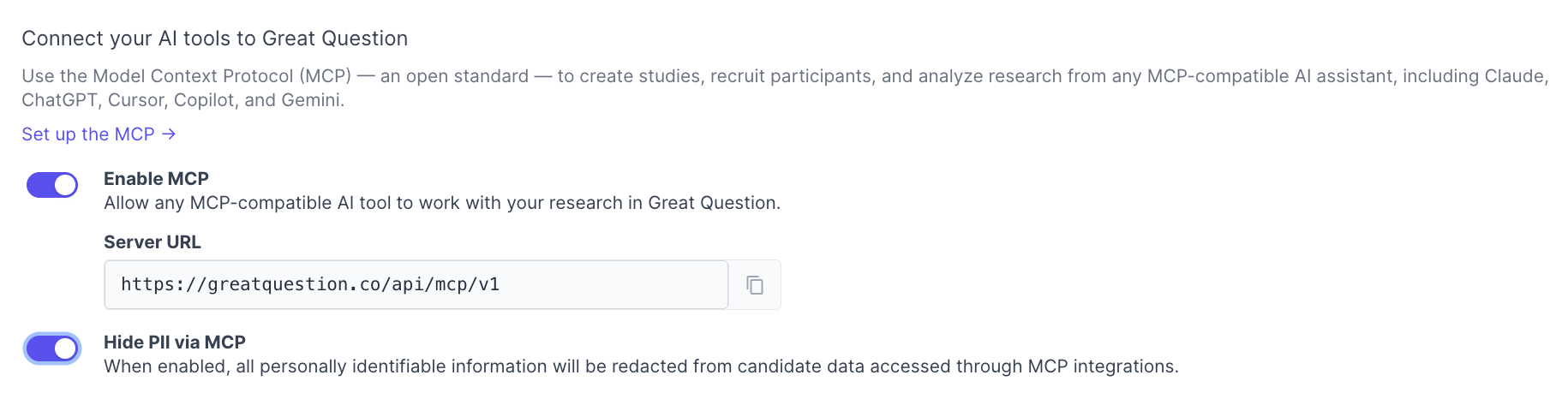
Claude Desktop
- Open Settings → Connectors → Add custom connector.
- Enter the name
Great Questionand the server URL above. - Click Save, then Connect. Authenticate via your browser.
- Restart Claude Desktop. Great Question tools will appear when you start a new chat.
Claude Code
Run in your terminal:ChatGPT/Codex Desktop app
- Go to Settings → Plugins → MCPs.
- Click + Add server, then enter:
- Name: Great Question
- Type: Streamable HTTP
- URL:
https://greatquestion.co/api/mcp/v1 - Leave other fields blank
- Click Save, and then authenticate.
Cursor
- Open Cursor Settings (Cmd/Ctrl + Shift + J), then select MCP from the sidebar.
- Click + New MCP Server to open your
mcp.jsonfile. - Add the following:
- Save the file, then click Connect on the settings page. Authenticate via your browser.
Copilot
There are two ways to connect your agent to an MCP server in Copilot Studio:- Add the MCP server in Copilot Studio by using the MCP onboarding wizard (recommended)
- Create a custom connector to your server through Power Apps
- Go to the Tools page for your agent.
- Select Add a tool.
- Select New tool.
- Select Model Context Protocol. The MCP onboarding wizard appears.
- Fill in the required fields Server name, Server description, and Server URL. Write a brief, but clear description of what your MCP server does. The agent orchestrator uses this information to identify whether to call your server at runtime.
- Server name: Great Question
- Server URL: https://greatquestion.co/api/mcp/v1
- Server description: Give the agent read and write access to Great Question’s research platform — studies, screeners, candidates, sessions, transcripts, highlights, and insights. Use it to create and configure interview, survey, and unmoderated studies, manage participants and recruitment, pull transcripts and screener responses, and search past research for findings and highlights.
- Select the authentication type for your MCP server, if applicable. You have three options:
- None
- API key: Configure API key authentication
- OAuth 2.0: Configure OAuth 2.0 authentication
- Create a new connection and add the MCP server to your agent.
- On Add tool, select Create a new connection for your MCP server or use an existing one.
- Select Add to agent to finish adding the MCP server to your agent.
Verifying your connection
Once connected, run through these quick checks in your MCP client:- See your studies. Ask for your recent studies. You should see titles, statuses, and IDs you recognize.
- Find participants. Ask for candidates in one of those studies. Names and emails should appear as expected.
- Pull a transcript. Ask for transcripts from that study, then request the full content of one. Look for speaker labels and timestamps.
- Connect the dots. Pick a participant and ask which studies they’ve appeared in, what sessions they had, and what their transcripts say.
- Try a write action. Create a test candidate or draft study to confirm write access is working. You can delete it afterward.
- Try a repo session. Ask for recent repo sessions, pick one, and request its transcript.
Connecting an agent (no human login required)
Beyond the browser-based OAuth flow above, an agent can now connect to Great Question entirely on its own, without a person driving it. Give the agent a secure API token once, and it authenticates automatically in the background whenever it needs to, with no repeated logins and no OAuth window to click through. The agent only has access to what the token’s associated user can already see in Great Question. Permissions and privacy work exactly like a normal login: if that user can’t see a given study, session, or candidate, the agent can’t either.Troubleshooting
OAuth window doesn’t appear? Make sure your browser allows popups from your MCP client. Some browsers block the OAuth redirect by default. Tools not showing up? Restart your MCP client after saving the configuration. If tools still don’t appear, confirm with your Great Question account team that your user has the feature enabled. An agent’s API token stops working? Tokens can be rotated or revoked from your Great Question account. Generate a new token for the agent and update it in the agent’s configuration. Since the agent only sees what its associated user can see, also confirm that user’s permissions haven’t changed. Can I query against two different Great Question workspaces? Each MCP connector can only be linked to one workspace at a time. If you work across multiple workspaces, you have two options:- Use a single connector and re-authenticate when switching. Disconnect the connector and authenticate it again to point it at a different workspace.
- Create a separate connector for each workspace. When you create a connector, you can give it a name to make the workspaces easy to tell apart, for example:
GQ-product-labGQ-dtx