

GQ-02 //// THE CUSTOMER DISCOVERY ARCHETYPES REPORT
AI was supposed to change customer discovery. But has it really? We asked ~180 designers at Config.
We wanted to know how product builders really run customer discovery now that AI is in every workflow, so at Config 2026 we ran an AI-moderated voice survey. Around 180 of them finished it. We asked: "before you commit to building something new, what's the first thing you do to know if it's worth building?" The results turned out to be stubbornly human.
Navigator · 58%
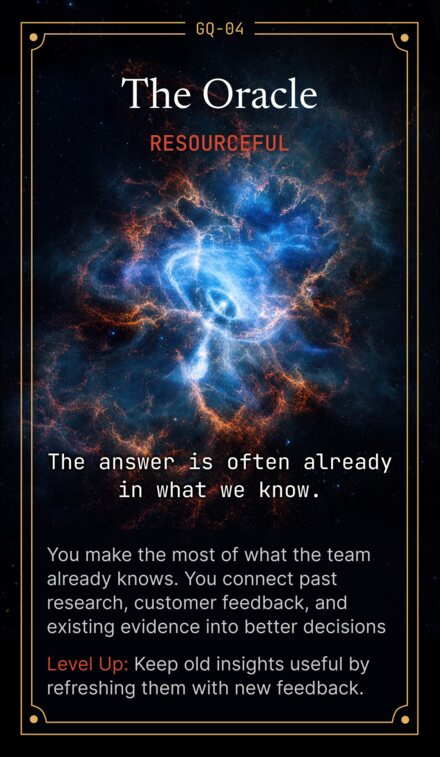
Oracle · 30%
Voyager · 9%
Alchemist · 3%
01 //// THE ARCHETYPES
The four customer discovery archetypes
At the Great Question booth at Config, we ran an archetype survey using our brand-new agentic moderator. Around 180 researchers and designers worked out which customer discovery archetype they fall into, meaning the default first move they make before committing to build something new. The results were interesting, and there was an overwhelming winner. Here are the four archetypes.
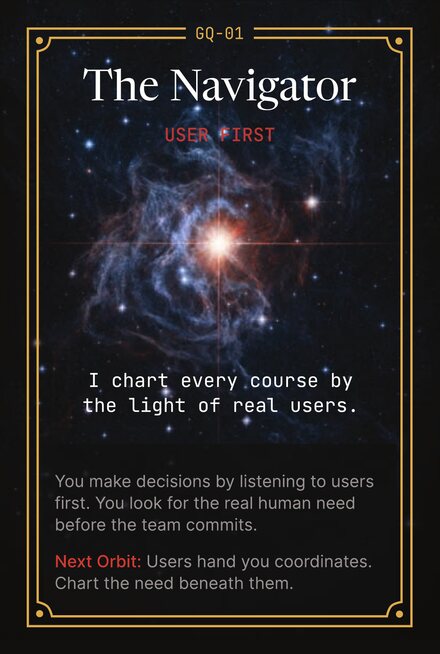
The Navigator
user-first
What you do
Go straight to real users. Before reading old research or building anything, they want fresh input from the people they’re designing for.
Your strength
Every decision stays tied to real customer signal, not the loudest opinion in the room.
Your blind spot
Lines up new interviews even when last quarter’s research already has the answer, then loses weeks to recruiting.
The Oracle
evidence-first
What you do
Start with what’s already known. Dig through old research and past notes before talking to anyone new.
Your strength
Never wastes a cycle re-learning what the team already figured out.
Your blind spot
Evidence ages. Acts on a finding that was true 18 months ago, and rarely puts a fresh user in front of today’s question.
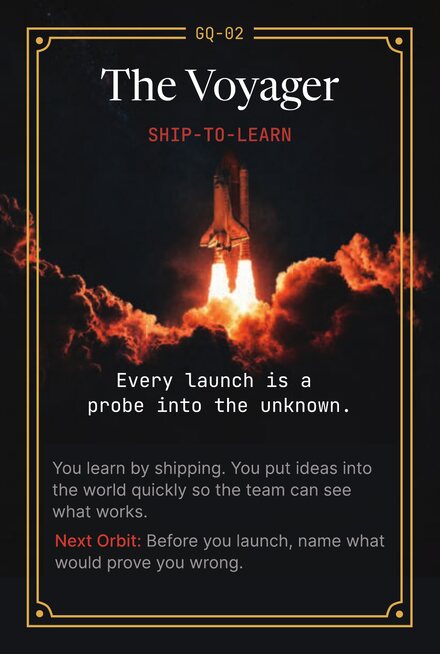
The Voyager
ship-first
What you do
Build it and find out. Put a rough version in front of people and learn from what they actually do.
Your strength
Moves while everyone else is still planning, and learns from something real instead of a slide.
Your blind spot
Shipping is the most expensive way to test an idea. Sometimes builds the whole thing a 30-minute prototype test would have killed.
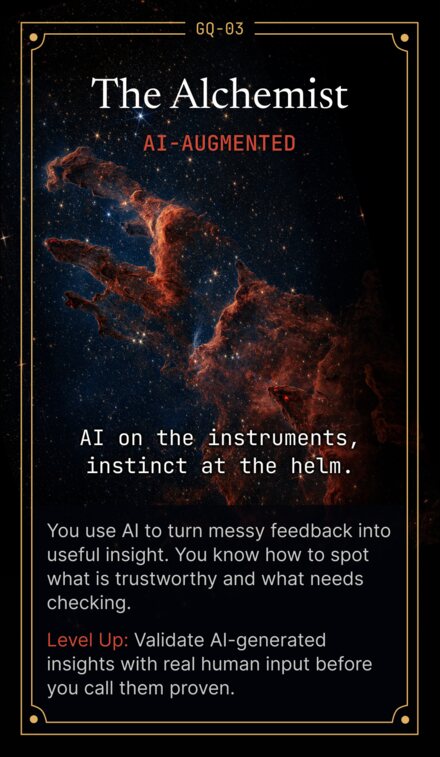
The Alchemist
AI-first
What you do
Ask AI first. Run the question through an AI tool to find patterns or build context before going further.
Your strength
Turns a week of digging through feedback into an afternoon of pattern-finding.
Your blind spot
AI only reflects what you feed it. You get confident answers no one can trace back to an actual customer.
Which one are you?
Take the 60-second archetype quiz
02 //// THE SPLIT
58% of designers scored as the Navigator
That means their first move is to go straight to a real user before anything else. The other three archetypes split what was left, and none came close.
58%
Navigator
talk to users first
talk to users first
30%
Oracle
use existing evidence
use existing evidence
9%
Voyager
ship to learn
ship to learn
3%
Alchemist
reach for AI first
reach for AI first
58% of product builders want user signal. Only 3% have automated getting it. For all the noise about AI-first workflows, AI barely registers as the opening move. Builders still reach for a person first. But talking to users is the easy part. Getting to a user is where the weeks disappear.
03 //// THE BIG PICTURE
The bigger the company, the more they reuse past research
Split the answers by company size and a clear pattern shows up. At 10,000+ person orgs, more designers start by digging into research that already exists: 35% scored as Oracles, versus 22% at startups. Bigger companies simply have more past research to pull from.
88%
start with a human
a live user (Navigator) or existing research (Oracle)
a live user (Navigator) or existing research (Oracle)
12%
start with a build or AI
ship to learn (Voyager) or prompt first (Alchemist)
ship to learn (Voyager) or prompt first (Alchemist)
For all the talk of AI-first and build-first workflows, almost nine in ten product builders still ground the customer discovery process in user research. The other approaches are growing, but they are still where roughly one in eight people start.
04 //// ON AI
AI is a second step, not a first move
Config is about as AI-forward a crowd as you will find, and AI sits in nearly every workflow in the room. Yet only 3% reach for it first when they start customer discovery. Read the few AI-first answers closely and the reason is clear.
Alchemist
“Built a tool to run product feedback through AI to find the pattern.”
Designer · Varicent
Alchemist
“Chat with AI to build context and figure out if it’s something the team really needs.”
Program manager · Cisco
Neither answer uses AI to replace talking to a user. Both use it to make sense of input they already have, to find the pattern or build the context. AI has landed in customer discovery as a synthesis layer, something you reach for once the human signal is in, not as the starting line.
05 //// THE COMPANY-SIZE CUT
58% of designers scored as the Navigator
Split the answers by company size and a clear pattern shows up. At 10,000+ person orgs, more designers start by digging into research that already exists: 35% scored as Oracles, versus 22% at startups. Bigger companies simply have more past research to pull from.
At small companies, far more designers just build it and find out: 15% scored as Voyagers, versus 0% at enterprise. Less to lose, faster to ship. At big companies that approach all but disappears, and the Oracle takes its place.
06 //// THE ROLE CUT
Does your role change your first move?
A near-pure sample of enterprise product designers (about two-thirds of the room), with UX researchers, PMs and a few engineers and founders making up the rest.
The ranking held across every role: Navigator first, Oracle second. The clearest signal came from UX researchers, who scored Navigator harder than any other group. The people whose whole job is research are the most likely to insist on talking to a fresh user. Roles beyond design are a small slice of the sample, so read the mix as approximate and directional.
07 //// Verbatims
In their own words
Here's some words lifted straight from conversations with our new agentic moderator.
Navigator
“Talk to real users first — prior research introduces bias because the context is different.”
UX researcher · United Airlines
Navigator
“Act on your hunch, talk with as many people as fast as possible, then keep refining the loop.”
Product & design lead · Buildpass
Oracle
“Old notes first — before talking to users or anything else.”
Designer · ServiceNow
Oracle
“Work it out from what I’ve got — piece together existing evidence before building.”
Product designer · ServiceNow
Voyager
“Built a tool to run product feedback through AI to find the pattern.”
Product design manager · Pilot
Voyager
“Put something in front of customers and watch what they do.”
CEO · AtlasGTM
Alchemist
“Built a tool to run product feedback through AI to find the pattern.”
Designer · Varicent
Alchemist
“Chat with AI to build context and figure out if it’s something the team really needs.”
Program manager · Cisco
08 //// UNDER PRESSURE
What gets cut when the timeline gets cut
We also asked what's first to go under pressure, and what they'd protect no matter what. The answers were strikingly consistent.
Testing survives almost every budget cut, while documentation and polish are treated as optional. Yet several designers, including self-described Navigators, said they'd sacrifice upfront user research before they'd cut testing or shipping. Talking to users is the stated priority, but it's also the first casualty when the clock runs out, which is exactly why research has to be fast enough to survive a deadline.
09 //// THE METHOD
How we ran this
Each response was a short spoken conversation with our new agentic moderator at our Config booth.
~180
designers and researchers
completed the survey
completed the survey
3m26s
median time
to complete
to complete
Every one of those conversations was run by the same agentic moderator that lives inside Great Question.
GQ //// The Agentic UX Research Platform
One archetype isn't enough
Great Question is the one platform that covers all four moves: recruit your own customers, run the study, keep every insight searchable, and ask AI across all of it. The average team replaces 12 tools with one.
Methodology. Data collected via an AI-moderated voice survey at the Great Question booth, Figma Config 2026 (24–26 Jun). Around 350 people started and ~180 completed (≈51%), median completion 3m26s. Each completer answered a single question ("before you commit to building something new, what's the first thing you do to know if it's worth building?") and was sorted into one of four archetypes by their stated first move. The headline persona split (Navigator 58% · Oracle 30% · Voyager 9% · Alchemist 3%) is reconciled to PostHog and the day-one pull; figures are rounded and may not sum to 100. Role and company-size cuts are drawn from the responses with full answer detail and are approximate. This is directional, self-reported data from a conference audience. It's strong for personas and logos, not a representative sample of the profession.