


Agentic AI Moderator
Why our agentic AI moderator is different
Agentic moderation
One format
Works across any method
Fixed script
Script or freestyle, your call
Limited controls
You set the limits
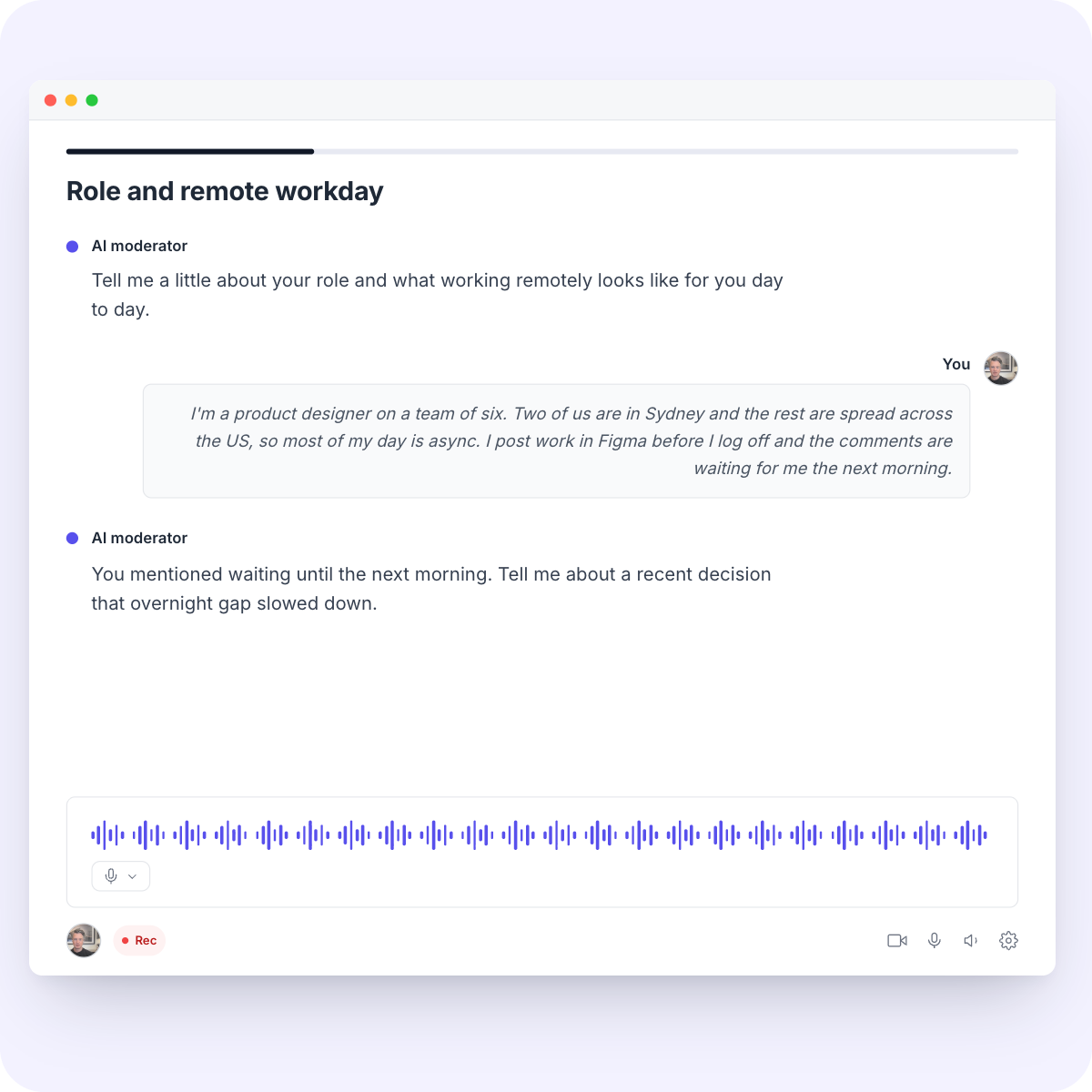
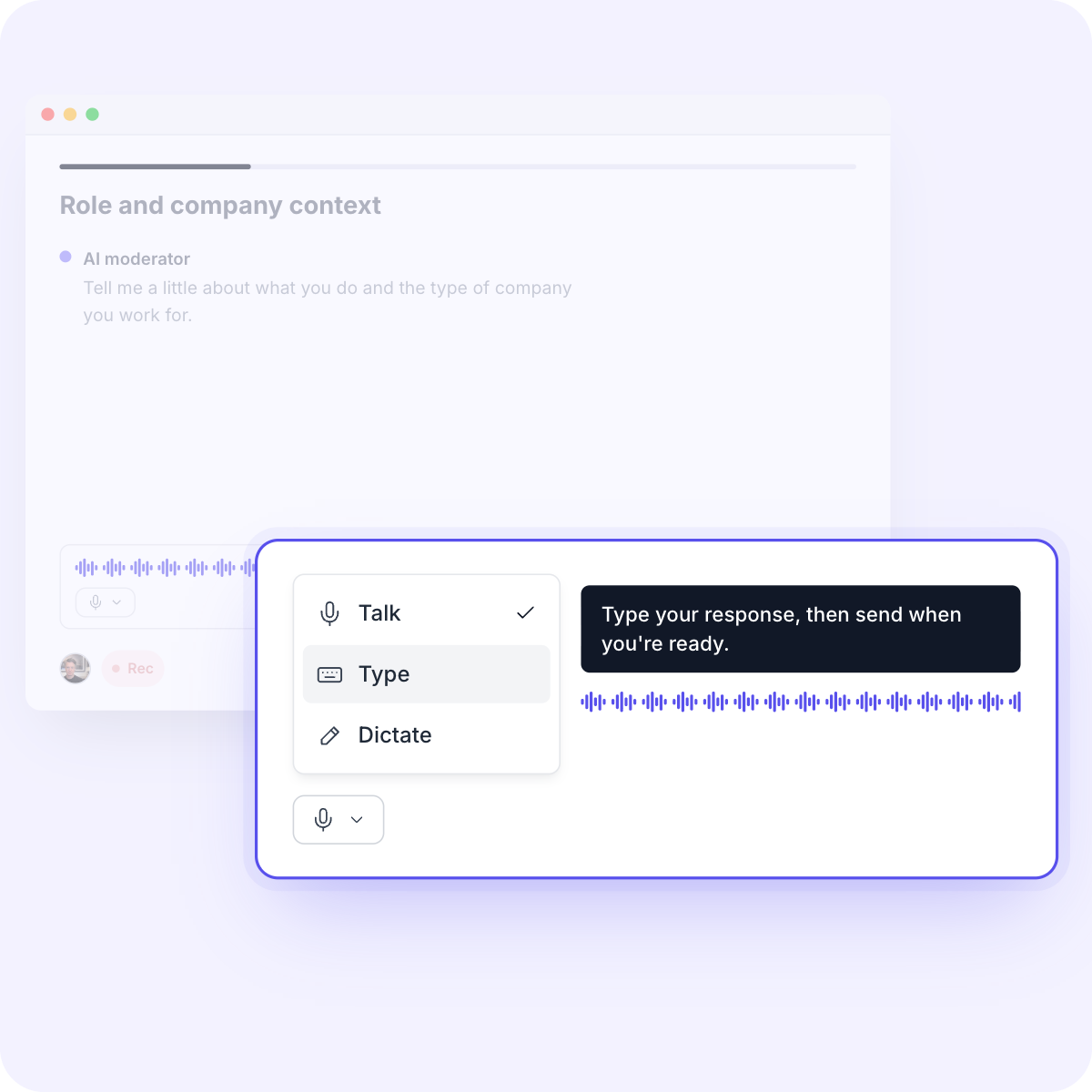
Hears only and only interactive through voice & text
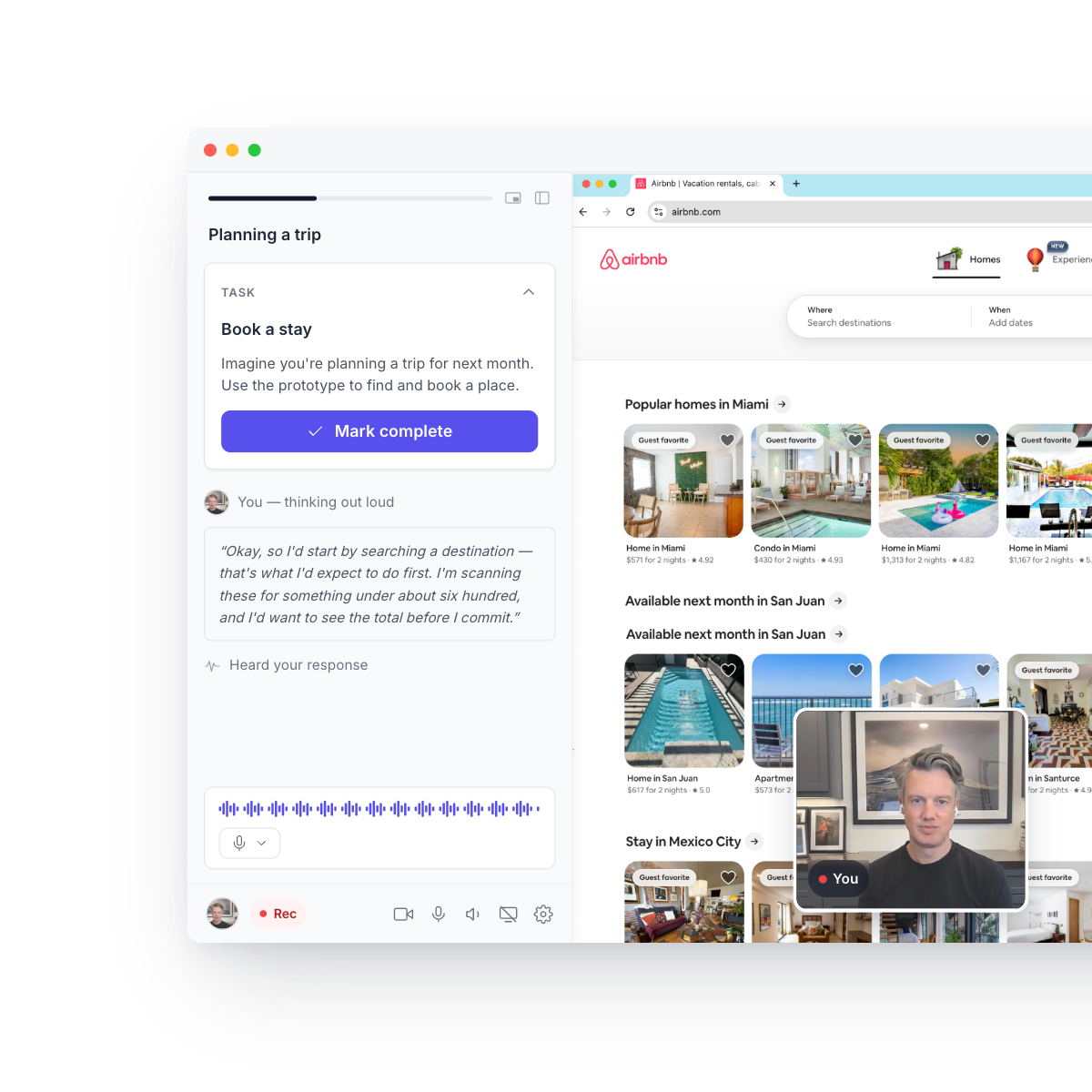
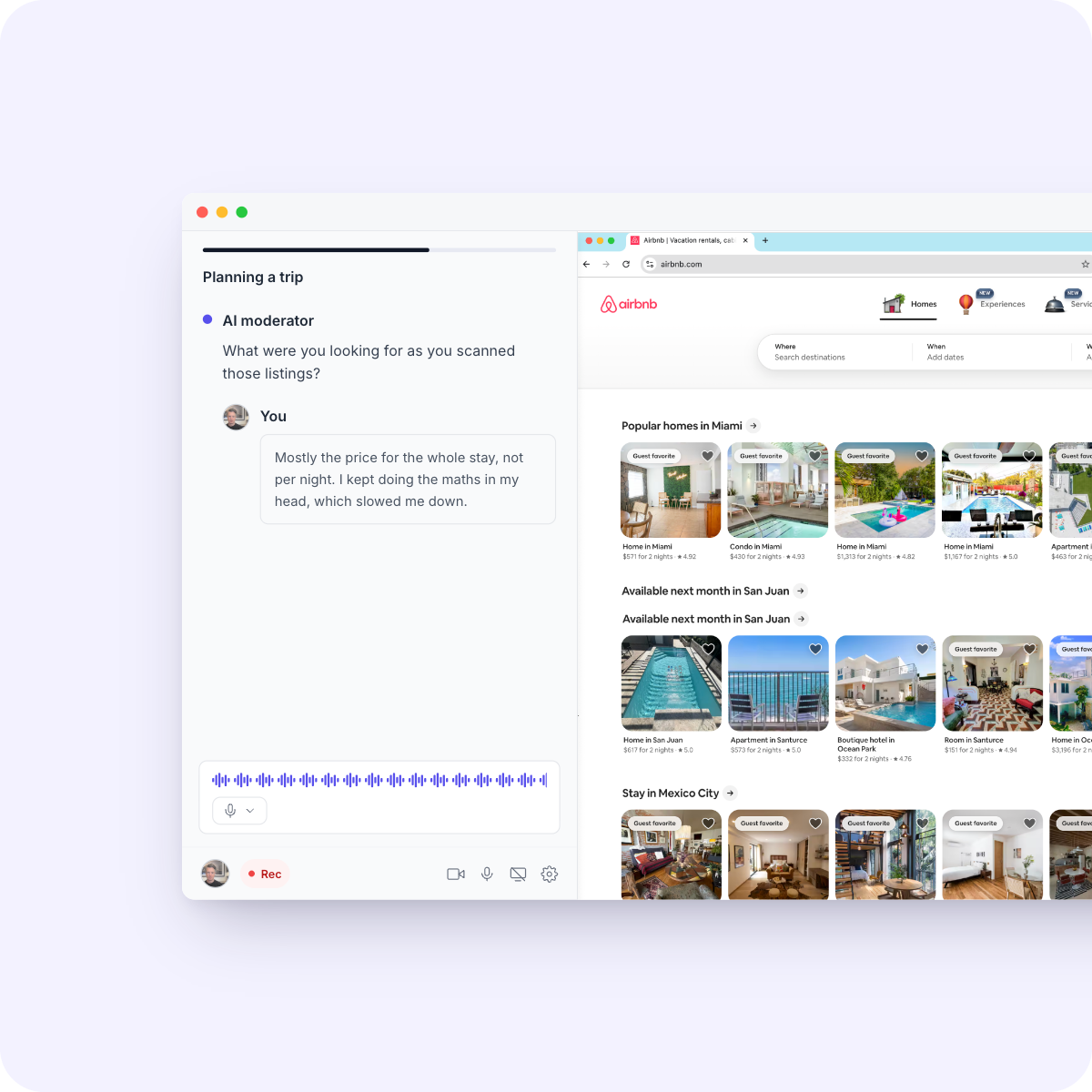
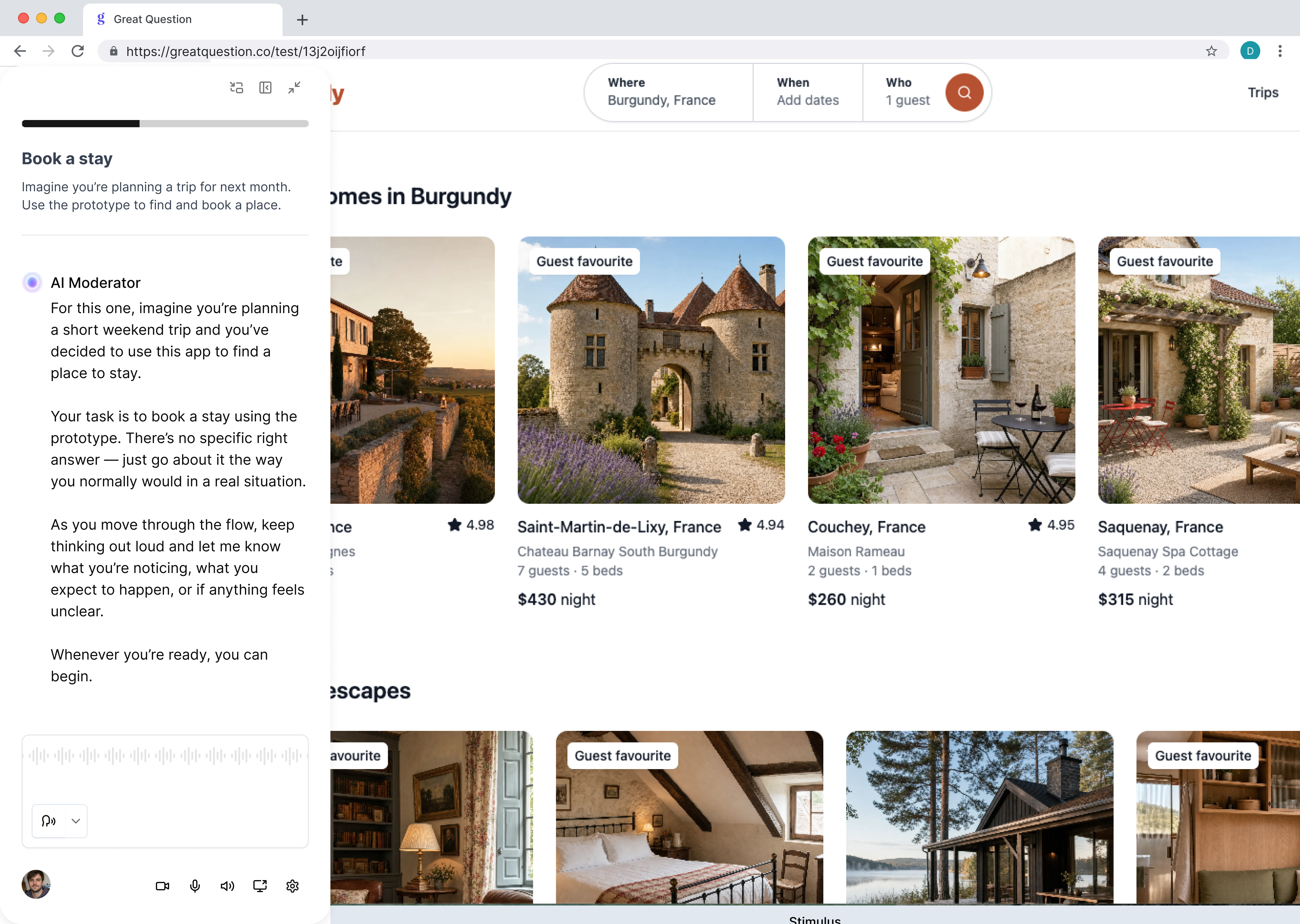
Follows on-screen behaviour (with prototype tests)
Choose the right approach for every study
AI moderation
Human moderation
Best for
High-volume discovery, continuous feedback, churn interviews, concept testing
Sensitive topics, complex emotional exploration, executive interviews
Scale
Hundreds of interviews in parallel, available 24⁄7
4–6 interviews per day per researcher
Consistency
Same core experience for every participant
Varies by researcher skill and energy
Follow-up depth
Adaptive probing based on response gaps
Deep contextual follow-ups, reads between the lines
Languages
Dozens of languages, instant localization* coming soon
Limited to researcher fluency
Scheduling
Async, participants complete on their own time
Calendar coordination required
Cost per session
Fraction of a live interview
Researcher time + recruiting overhead
Time to insights
Automatic transcription, highlights, and synthesis
Manual transcription and analysis
Frequently asked questions
English at launch, with more languages on the roadmap. If you're running a multi-market study, talk to us about timing.
Every AI moderated interview runs on Great Question's infrastructure with the same enterprise-grade security that covers the rest of the platform. Data is encrypted in transit and at rest, transcripts are stored in your research repository (not shared with third-party model providers for training), and you control data retention policies from your workspace settings. For teams with specific compliance requirements — SOC 2, GDPR, HIPAA — reach out to our team to walk through the details.
- Meets you where you’re at: Our AI features are thoughtfully designed to augment your existing research workflows on Great Question
- Pre-integrated: Each AI query receives the right data and context it needs to perform the task, resulting in responses that are relevant and high-quality.
- Query large studies: You can easily query large studies with up to 1000s hours worth of interview transcripts, something that isn’t possible with tools such as ChatGPT.
- Security and privacy controls built in: Data containing PII is automatically masked by Great Question, and data will not be used by 3rd parties for training future models.
For high-volume discovery research, AI moderation consistently surfaces insights that manual interviews miss — because it can run hundreds of conversations in the time it takes to schedule one. The AI adapts its follow-up questions based on what each participant says, so you get depth without a rigid script. Where human moderation still wins: sensitive topics, complex emotional exploration, and situations where reading body language matters. Most teams use both. See our comparison guide for a breakdown by study type.
There's no practical cap. Teams regularly run hundreds of AI interviews in parallel — participants join on their own schedule, 24/7, and complete interviews asynchronously. You're not limited by moderator availability, time zones, or calendar logistics. If you can recruit them, the AI can interview them.
Yes, to whatever degree you want. Hand the agent a topic and a goal and it'll work out the questions. Or write every question yourself and have it ask them exactly as written. Or sit somewhere in between. You set the limits and it works within them.
Yes. You write the discussion guide — the questions, the topics you want to cover, and the areas where you want deeper follow-up. The AI moderator uses your guide as a framework, not a rigid script. When a participant gives a short or surface-level answer, the AI probes deeper on that specific response. You can also set priorities: which topics to spend more time on, which to skip if time runs short, and what kinds of follow-ups to emphasize. It's your study design with adaptive execution.
It varies between different AI features, but we generally supply anonymised interview transcript excerpts, study metadata (e.g. research goal), and tagged highlights to the AI to produce responses.
Usage of AI features is not limited, but is subject to fair use policies.



.png)


