Most teams have never had more data about their customers. NPS scores, satisfaction surveys, transaction logs, cancellation reasons, website polls. And yet ask a simple question (why are customers buying this, or why aren't they) and the room goes pretty quiet.
We sat down with Hannah Shamji, a consumer psychology researcher and former psychotherapist who's spent 15 years helping teams like Shopify Plus, Toyota, and HubSpot get past surface-level data and into how their customers actually make decisions.
Her core point: you can have all the data in the world and still miss the one thing that moves the business.
"Know your customer" is one of those phrases everyone nods along to and nobody really defines. So Hannah built a model to pin it down: four concentric circles, with the customer sitting in the middle.
The further out you are, the easier the data is to collect, and is less reliable.
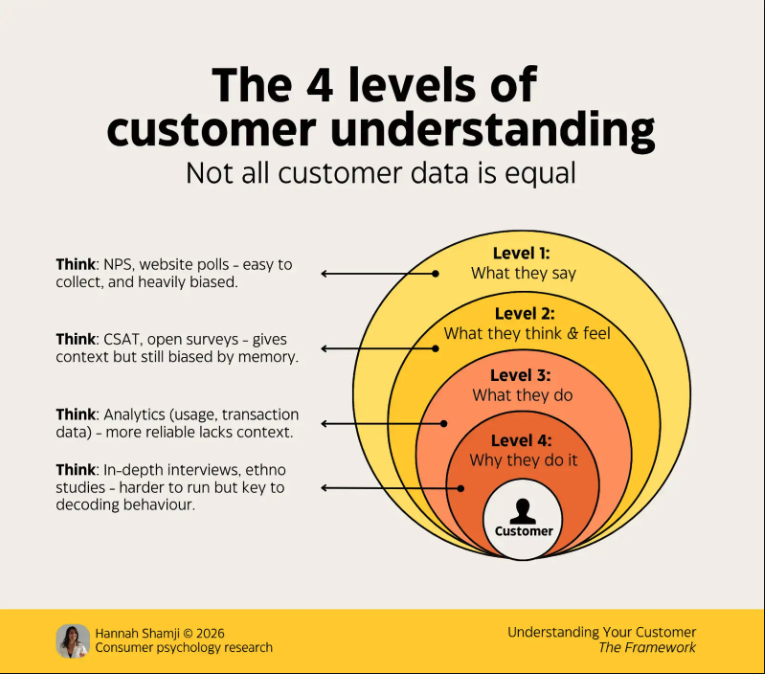
Level 1: what they say. NPS, website polls, quick surveys. No moderator, no accountability, so people tell you whatever's top of mind, often because they're short on time or annoyed about one specific thing. Easy to gather. Loaded with bias.
Level 2: what they think and feel. Open-ended survey questions, customer satisfaction. A better window into what people care about, but still filtered. Someone might rave about a feature they never actually use, or flag a frustration that happened once.
Level 3: what they actually do. Purchase data, conversion data, churn. Now you're on firmer ground. People can say anything about your product, but do they pull the trigger? Do they subscribe, or cancel? Behavior doesn't lie the way opinions do.
Level 4: why they do it. This is the gold, and it's the hardest to collect. It's the translation layer that explains everything else: why people say one thing and do another, why they "know better but don't do better." It's mostly about context. The same person dresses differently for a weekday at the office than for a weekend or a vacation. Everyone carries a decision matrix in their head, and level four is where you finally read it.
The outer rings still matter. What people choose to share is their worldview, and you need to meet them there. But most teams never reach the center, which is exactly where the pieces tie together.
The clearest signal is a gap between what people say and what they do.
Someone tells you they didn't buy because of price. Fine, but if you only have what people say, assume it's carrying bias. When people say they love a product and then don't buy it, or buy it and never use it, that gap is your cue to dig.
Hannah's favorite example is health. We all think we're healthy, but we're not as consistent as we often tell ourselves we are. Stop asking "why." Start asking "what happened."
To get at the why, Hannah almost never asks "why."
"Why did you buy?" sounds like a tidy question, but it's nearly impossible to answer honestly. Think about how "why" lands in everyday life. Why didn't you text me back? It's pointed and charged, and it pushes people to invent a clean, logical reason after the fact. That's the opposite of what you want.
So she flips it to "what." She maps a timeline before every interview: a trigger on one end, the decision she cares about on the other. Landing on the website through to signing the contract. Then the whole conversation becomes unpacking the documentary of what happened in between. What happened after? How long between the proposal and the signature? Who did you talk to? Who was on the demo?
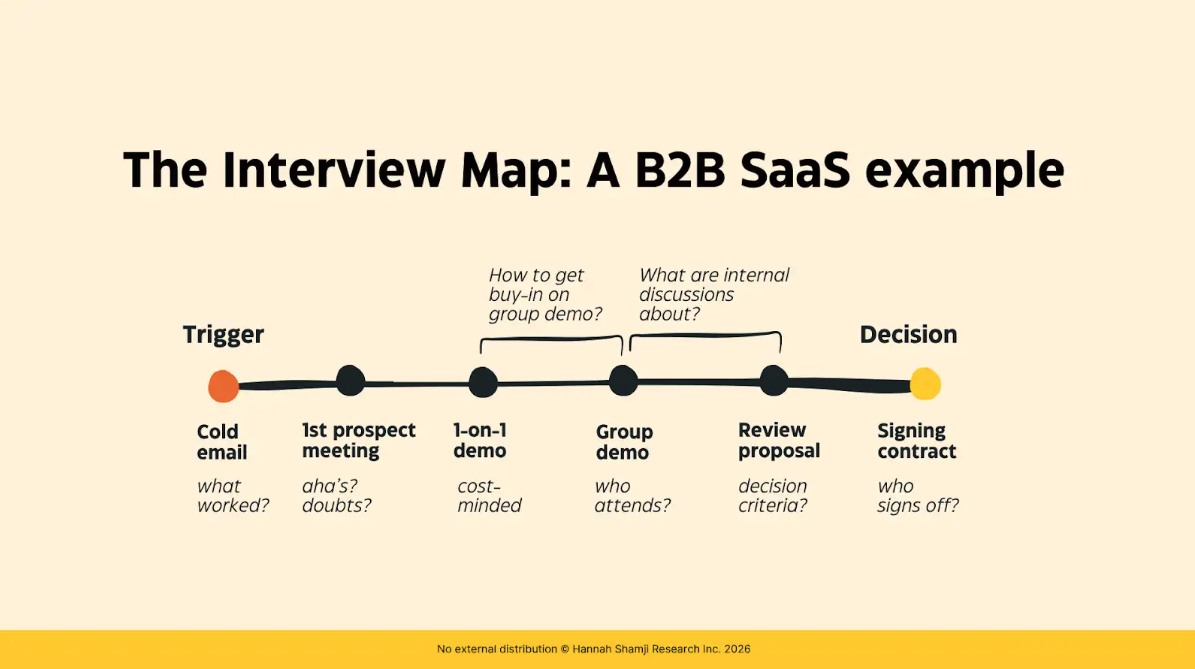
Suddenly you're asking about concrete events instead of asking someone to narrate their own psychology. It stops feeling like filling in blanks and starts feeling like reporting. People's instinct is to gloss over the messy middle and hand you their tidy version, so your job is to keep pulling them back into the details. And then what? And then what?
The premise underneath it: a decision like buying or cancelling or subscribing is never a single moment. Even an impulse buy isn't really instant. It's a crescendo, the last domino, the final tipping point after a string of smaller ones. Study those micro-decisions and the timeline gives you real detail about who else was involved, the actual sequence of events, and where the pressure came from.
One more move worth stealing: reverse-engineer the timeline from the thing you want to change. If the job is improving an ads-to-quiz-to-conversion sequence, interview people who came in through an ad and did the quiz, so every part of the timeline maps back to an asset you can actually influence.
If you only talk to customers who bought, everything in the "why" looks important. Talking to the people who didn't forces priority.
Maybe everyone who converted mentions your great price, but the people who walked away aren't talking about price at all. They're talking about something else entirely. Same timeline, different decision point. It strips out the happy bias you get from only studying the behavior you wanted, and it tells you whether the reasons you're proud of actually matter.
It's the Anna Karenina principle, basically: happy customers tend to look alike, but every unhappy one is unhappy in their own way, and those ways are where market expansion and new products often hide.
In-depth interviews are the gold standard for the why. But if you can't justify the time or the skill-building yet, there's plenty of scrappier ground to cover first.
Start with a survey. There's usually more internal appetite for one anyway. Play with open-ended and forced-choice questions you can pit against your behavioral data. Interview your own sales and customer success teams; they're on the frontline and see the gaps. Mine reviews, testimonials, support tickets, call recordings. Stack a few of these buckets and see if they agree. When your BD team and your survey say the same thing, that's your justification to go deeper.
The point is to build a business case for research before you spend on it. As Hannah puts it, a lot of teams come in saying "we want to talk to customers" when the real question is "do we already have enough to make this decision?"
AI is a useful research assistant. It's fast at the parts that aren't fundamental: counting how many customers raised a theme, pulling quotes, giving a cursory first pass on transcripts, combing survey and anecdotal data. Not using it would slow you down for no reason.
What it doesn't do well is the deeper narrative, and context is where it can fall down. At Great Question we've been through many iterations of our analysis features because researchers kept asking, "wait, where did this come from?" That's why every insight links back to the original clip.
Without context, insights can get conflated. Let's say someone runs research about tables, and along the way a participant says they love chairs. Later you research chairs and the tool happily reports "people love chairs," without flagging that it was said in the context of tables. Ask it what to put by the pool and it might suggest a chair when a lounger was always the better answer. The citations are what let you catch it.
You'd think the people most into research would go deepest. Often it's the reverse. When you love it, everything becomes "let's talk to customers, let's run a survey," and you spin in busy work, learning constantly without moving much.
Not everything needs research, and not everything that does needs deep research. The discipline is pairing research with the business decision upfront: do we have what we need to decide, and if not, what's the fastest way to fill the gap? Save the real investment for the high-impact, high-uncertainty questions. That's where it earns its keep.
Or as Hannah landed it: the best research is sometimes no research at all, if you can get away with it.
Hannah Shamji is a consumer psychology researcher and the founder of Hannah Shamji Research Inc. She's writing a book on her interview method.



Harri is Chief of Staff at Great Question and a former qualitative researcher at Meta. Harri works across strategy and operations, and regularly hosts conversations with research, design, and product leaders about how AI is changing the way teams understand their customers.