Table of Contents
Screeners
Updated
by Gina Romero
Screeners
Screeners are short questionnaires that qualify or disqualify participants before they join your study, ensuring you engage with the right people for your research.
What are Screeners?
Screeners let you ask candidates a set of questions before deciding whether to invite them to your study. Based on their responses, candidates are automatically or manually qualified, disqualified, or routed to follow-up questions using conditional logic. This keeps your participant pool focused and your data clean without requiring manual review of every applicant.
Why It Matters
Target the right participants. Screeners filter out candidates who don't meet your research criteria — whether that's job role, experience level, product usage, or any other factor — so you only engage with people who match your study's requirements.
Save time on qualification. Auto-qualification and auto-disqualification remove the need to manually review every candidate, especially when recruiting externally or running high-volume studies.
Maintain consistent standards. Every candidate is evaluated against the same criteria, reducing bias and improving data quality across studies.
Create dynamic routing. Conditional branches let you guide candidates to different questions based on their responses, keeping the screener experience relevant and concise for each person.
How to Enable a Screener
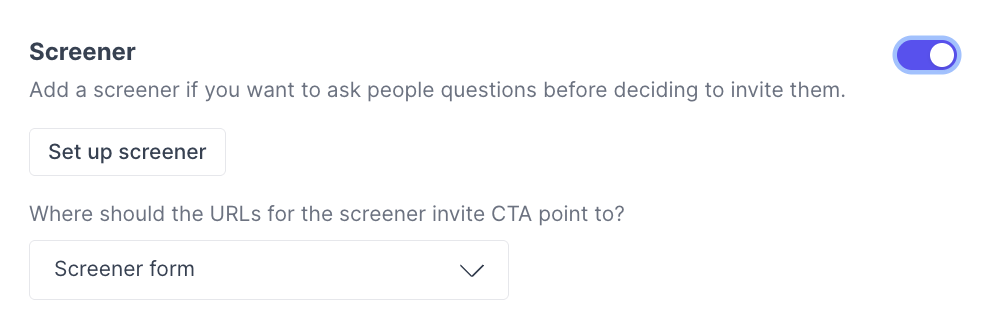
- Either when creating a study or adding it after it's published, enable the Screener under Plan in your study.
- Add questions using the question builder. You can drag and drop to reorder questions.
- For each question, configure qualifying logic, disqualifying logic, or conditional branches using the Question Logic panel.

- Open Screener Logic in the header to configure your overall qualification and disqualification review settings.
- Use the Preview button to test your screener flow from the candidate's perspective before publishing.
- Save your screener.
Question Types
Screeners support a range of question types to help you gather the right information:
Type | Description |
Short Text | Single-line text response |
Long Text | Multi-line text response |
Single Select | Choose one option from a list (radio buttons) |
Multi Select | Choose one or more options from a list (checkboxes) |
Yes / No | Simple yes or no question |
Number | Numeric input |
Linear Scale | Numeric scale with custom min/max labels |
Email address input | |
Website | URL input |
Date | Date picker |
Location | Location input |
Matrix | Grid/table-style question with rows and columns |
Info | Informational text block (no response collected) |
For each question, you can mark it as required so candidates must answer before continuing, add helper text to provide additional context below the question, add an image to accompany the question, or add an "Other" or "None of the above" option to choice questions.
Setting Up Qualifying and Disqualifying Answers
You can mark specific answers as qualifying or disqualifying to streamline your review process. Each question can have its own logic configured independently.
Qualifying Answers
Qualifying answers identify responses that match your ideal participant criteria. When a candidate's answers match your qualifying rules, they are flagged as a qualified candidate.
To set qualifying answers, click on a question in the screener builder, open the Question Logic panel, add a rule, and select Mark qualifying. Choose the condition and specify the answer value(s), then save the rule.
The available conditions vary by question type:
Question Type | Available Conditions |
Choice questions (Single Select, Multi Select) | Is exact match, Is not, Contains all of, Contains any of, Contains none of |
Text questions (Short Text, Long Text) | Contains, Doesn't contain, Starts with, Ends with, Equals, Doesn't equal |
Number questions | Equals, Greater than, Less than, Within (range) |
Yes / No questions | Is, Isn't |
Date questions | After, Before, Between |
Disqualifying Answers
Disqualifying answers identify responses that should screen a candidate out. If a candidate selects any disqualifying answer, they are flagged as disqualified.
To set disqualifying answers, follow the same steps as qualifying answers but select Mark disqualifying as the rule outcome.
Conditional Branches (Skip Logic)
Conditional branches let you route candidates to different questions based on their answers. This is useful when certain follow-up questions only apply to specific groups of candidates.
To add a conditional branch, click on a Single Select, Multi Select, or Yes/No question, open the Question Logic panel, add a rule, and select Go to. You can then choose which question to skip to, or select one of these end options:
The final step ends the screener normally. The final step (and exclude from automatic review) ends the screener but excludes the candidate from automatic qualification, even if all their other answers are qualifying. The final step (without collecting the response) ends the screener and does not store the participant's data, which is useful for privacy compliance when disqualified candidates' data should not be retained.

Configuring Review Settings
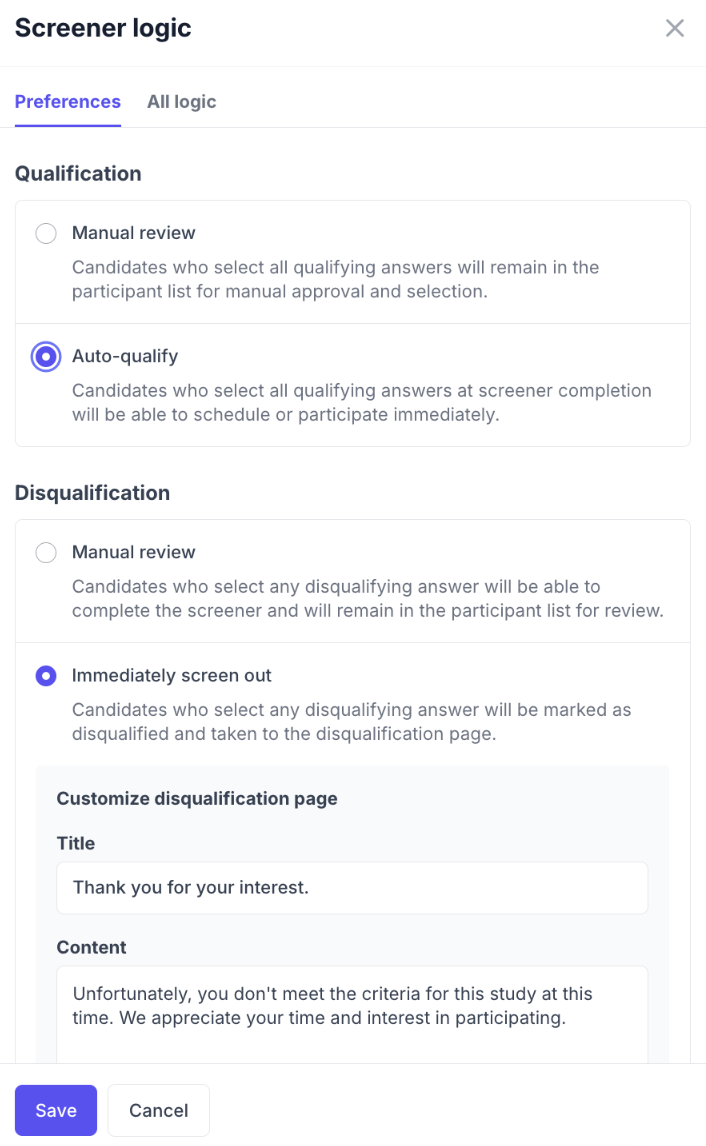
Screener Logic controls how candidates are processed after completing your screener. Click Screener Logic in the header to access the Preferences tab, where you define how qualified and disqualified candidates are handled.
Qualification Review
Manual review is the default. Candidates who match all qualifying answers remain in your participant list under the Applied tab for you to manually approve and select. Each candidate is tagged as Qualified, Partial, or No data based on their responses.
Automatic review allows candidates who match all qualifying answers to schedule or participate immediately without waiting for your approval. For interview studies, qualified candidates can schedule right away. For unmoderated studies, they can start their task immediately.
Disqualification Review
Immediately screen out is the default. Candidates who select any disqualifying answer are shown a custom disqualification page right away and marked as Removed with a disqualification tag.
Manual review allows candidates who select a disqualifying answer to complete the full screener. They remain in your participant list under the Applied tab with a Disqualified or Partial tag and a count of disqualifying answers versus total questions.
Understanding Qualification Statuses
After candidates complete your screener, each response receives a qualification status. You can filter and sort your participant list by these statuses and by the number of qualifying or disqualifying answers.
Status | Meaning |
Qualified | The candidate selected all qualifying answers and none of the disqualifying answers. |
Disqualified | The candidate selected at least one disqualifying answer. |
Partial | The candidate selected at least one qualifying answer and no disqualifying answers, but did not match all qualifying criteria. |
No Data | The screener may not have had qualifying criteria set, or the candidate did not complete it. |
Reviewing All Logic at a Glance
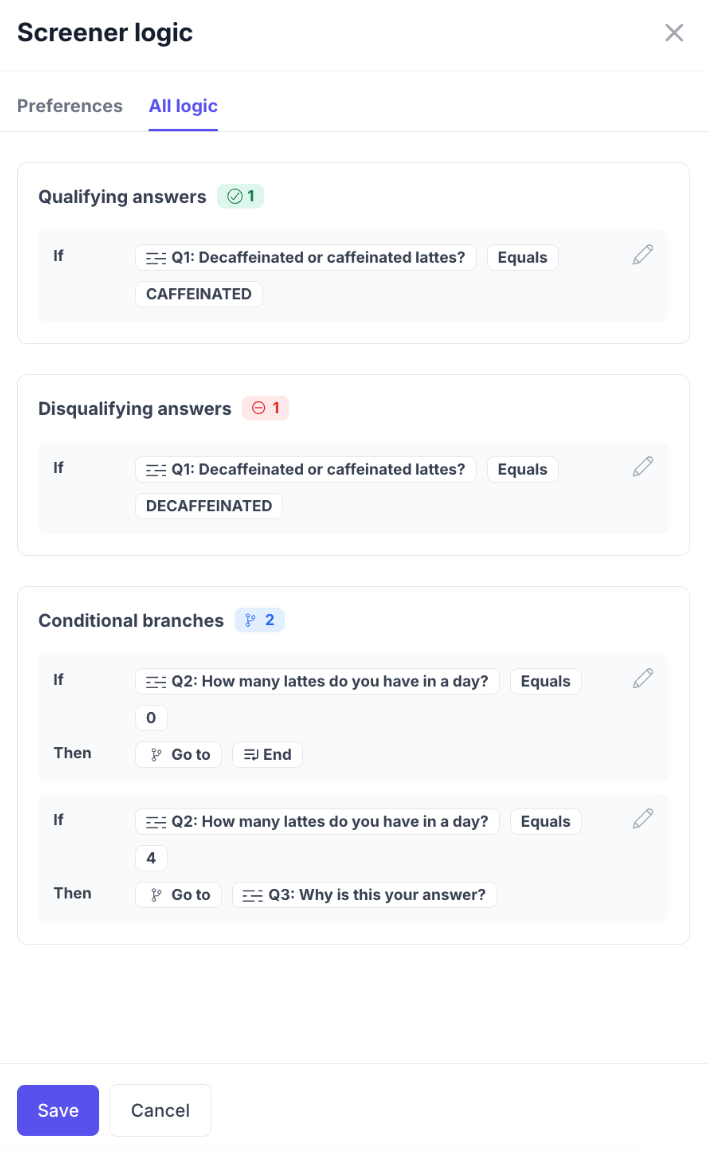
To see a summary of all logic configured across your screener, open the screener builder and click the settings icon to open the screener configuration panel, then navigate to the All Logic tab. This tab shows three sections: Qualifying answers (all questions with qualifying rules), Disqualifying answers (all questions with disqualifying rules), and Conditional branches (all questions with skip logic). If any section is empty, you will see a prompt to create rules at the question level. You can also jump directly to any question from this view to edit its rules.
Updating the Screener Headline
To change the headline displayed at the top of your screener, go to Setup and click Pages. Under Landing page, click Edit, then update the Headline field. This headline appears on both the study landing page and the screener page.

Publishing Requirements
Before publishing your study with a screener, make sure you have met these requirements:
Your screener must have at least one question. If you are using external recruitment, you need at least two questions. If automatic review is enabled, you must specify qualifying answers for at least one question. External recruitment also requires qualifying answers for at least one question.
Best Practices
Before launching your screener, always preview the full flow to confirm your logic works as expected. Check that conditional branches lead to valid follow-up questions and that qualifying and disqualifying tags are set on the right answers.
When designing your questions, keep it short. Candidates are more likely to complete shorter screeners, so focus on the criteria that matter most. Use qualifying and disqualifying answers together — qualifying answers help you find great participants, while disqualifying answers filter out mismatches early. Use conditional branches to skip irrelevant questions and keep the experience concise.
After launching, customize your disqualification page to maintain a positive candidate experience. Consider automatic review for high-volume studies to speed up recruitment. Combine screeners with saved templates from the Library to maintain consistency across studies.
Troubleshooting Screeners
Issue | What's Happening | How to Fix It |
Screener questions aren't showing in preview | The screener wasn't saved or published after editing. | Go back to the Screener setup, click Save, and ensure your study status is Published. |
Participants aren't being auto-qualified/disqualified | Logic rules or answer tags weren't set correctly. | Open each question's Question Logic panel and confirm that qualifying/disqualifying answers are selected. If automatic review is enabled, confirm at least one question has qualifying answers specified. |
Conditional branches not working as expected | Branching logic was applied to an unsupported question type or a response path is missing. | Conditional branches are only supported on Single Select, Multi Select, and Yes/No questions. Review the All Logic tab to verify each rule leads to a valid next question. |
Disqualified candidates still appear in the "Applied" tab | Manual review mode is active instead of "Immediately screen out." | Go to the Preferences tab under Screener Logic and enable Immediately screen out for disqualifying answers. |
Qualification tags (Qualified / Partial / No data) missing | Candidate didn't complete all questions or logic didn't include any qualifying rules. | Check that at least one question has a Qualifying answer and test with a complete response. |
Screener data not showing in Participant table | Responses were not stored due to privacy settings. | Disable Don't Store Participant Responses in Screener settings if you want to retain disqualified candidate data. If a conditional branch is set to The final step (without collecting the response), data for those candidates will also not be retained. |
FAQ
Question | Answer |
What happened to "Ideal Answers"? | Ideal Answers have been replaced with qualification rules at the question level. You now tag answers as Qualifying directly within each question's logic settings using conditions like "Is exact match," "Contains any of," or "Greater than." |
Do I need to update existing screeners? | No. All legacy screeners have been migrated automatically and will continue to function as before. |
Are there minimum requirements for a screener? | Yes. You need at least one question for standard studies, or at least two if using external recruitment. If automatic review or external recruitment is enabled, at least one question must include qualifying answers. |
Still need help? Contact us at [email protected] — we're happy to help!