

What is candidate eligibility?
Eligibility rules are account-wide criteria that Admins set once and that apply automatically to every study. A candidate who matches any rule is Ineligible and is left out of study invitations by default until they stop matching it. Whoever sends the invite can still choose to include them (see Inviting ineligible candidates). Rules help you avoid over-recruiting the same people, respect consent, and keep show-up rates high, which matters most when many people across your company run research. Each candidate has one of three eligibility statuses: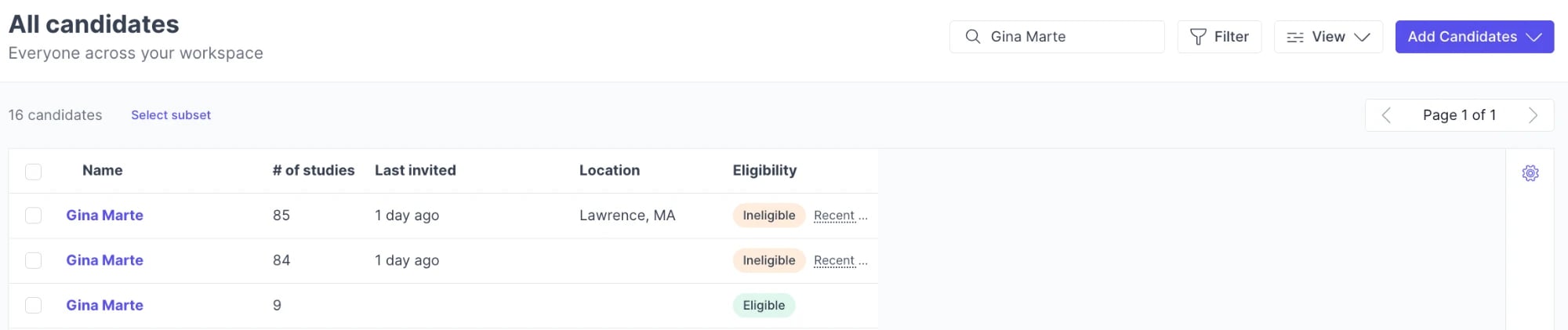
Why it matters
See the reason, not only the result. Profiles, the candidate slide-out, and tables show which of your own rules a candidate matches, so nobody has to guess why someone was left out of an invite. Know when someone can be invited again. For rules with a time window, the profile shows the date the candidate becomes eligible again. Invites don’t block their own study. Inviting someone to a study, including to its screener, no longer makes them ineligible for that same study. Limit repeat participation. Add rules like “no more than one completed study every 90 days” so the same people don’t take part in every study.Common use cases
The five default rules
Every account comes with five default eligibility rules:
On Enterprise plans, Admins can adjust each threshold and add their own rules.
Where to find eligibility settings
Go to Account Settings → Governance → Candidate Eligibility. Any account member can view the rules. Only Admins on Enterprise plans can create, edit, or delete them.Creating a rule
- Click Create rule.
- Enter a Title and a Description. The description is shown to your team when they hover over the rule, so write it in plain language.
- Add the Criteria that make a candidate ineligible (see Available criteria). Choose whether a candidate must match all or any of the criteria.
- Add a short Label. This is what your team sees next to Ineligible in tables and on profiles, so keep it to a word or two, for example Recently participated.
- Click Create.
Available criteria
These criteria are based on a candidate’s research activity. Each one can be used once per rule.
You can also build rules from the candidate’s details: their Join date, the Studies they’ve taken part in, Segments, Affiliation (if your account uses teams), opt-in and unsubscribe status, and any standard or custom attribute in your account.
Limiting repeat participation
To give participants a break between studies, use the Completed study count criterion. By default it’s set to is greater than 0 studies in the Last 90 days, which means anyone who completed a study in the past 90 days is ineligible until 90 days after that study. The period can be Last 30 days, Last 90 days, Last 180 days, Last 365 days, All time, or Custom.Only completed studies count toward this rule. Invitations, screeners, bookings, and no-shows on their own do not.
Choosing a timeframe
Criteria that count activity over a period (such as invitations sent, responses, or completed studies) include a timeframe dropdown. Pick one of the presets, or select Custom to set your own interval. Selecting Custom reveals a day-count input that accepts any whole number from 1 to 9999. Use this when a preset doesn’t fit. For example, set a 45-day gap between contacts when one month is too short and two months is too long. Values outside the 1–9999 range are clamped to the nearest bound, and Apply is blocked with a Required message if the field is empty.Managing rules
From the Candidate Eligibility page, Admins can edit a rule using the pencil icon or delete it using the trash can icon. Changes apply across all studies, and each candidate’s eligibility updates automatically, including when a rule’s time window ends.Seeing why a candidate is ineligible
In tables
The Eligibility column on the Candidates page and on every tab of a study’s Participants table shows the candidate’s status and, if they’re ineligible, the labels of every rule they match. Hover over the status to see each rule’s title and description.On a profile or in the slide-out
A candidate’s profile and the candidate slide-out show an Eligibility row below their email, listing each rule that applies. Hover over a rule to see when its window ends, for example Window ends after Nov 6, 2026. When every rule a candidate matches has a predictable end date, the profile also shows Eligible again after with the date they can be invited again.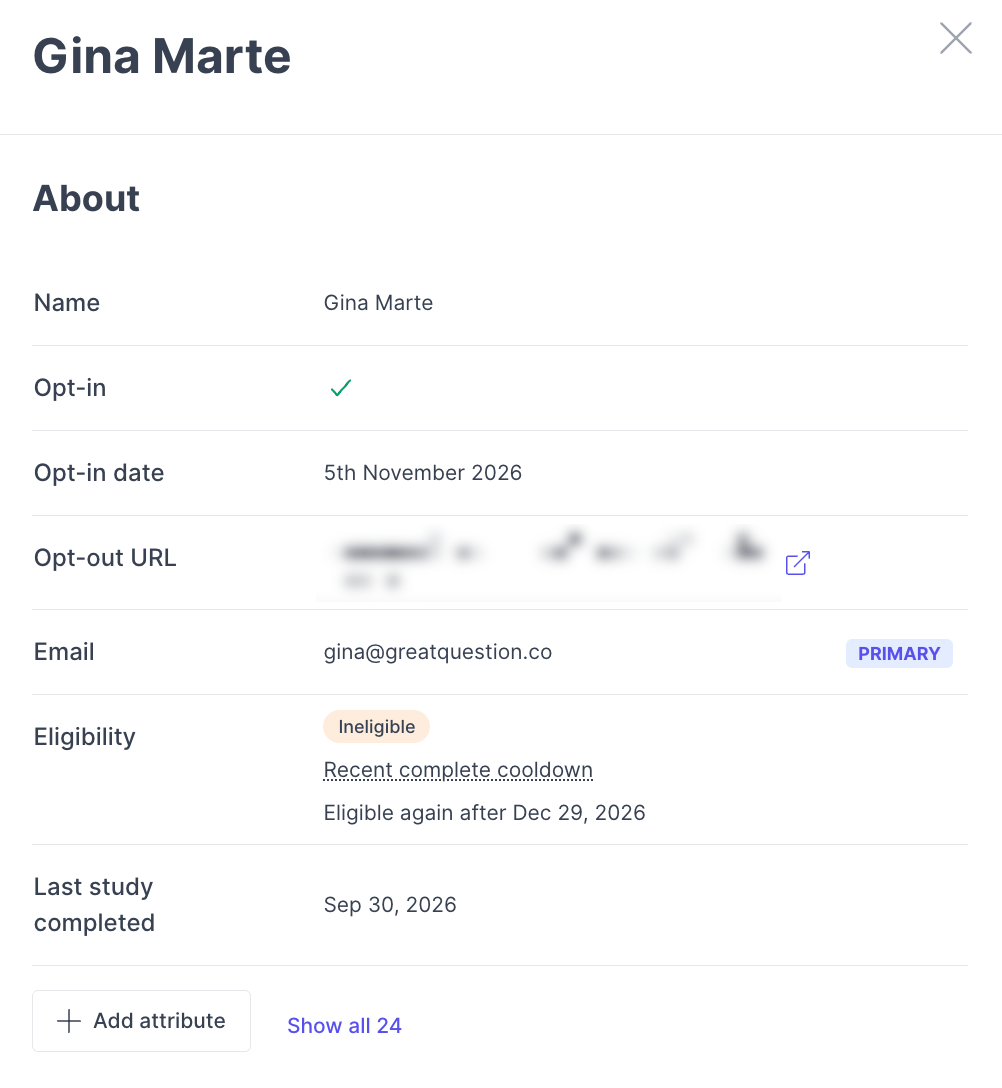
No return date is shown when a rule doesn’t expire on its own: consent, response rate, and participation rate rules, and no-show or invitation rules set to Indefinitely. Unsubscribed candidates never show a return date.
Inviting ineligible candidates
Eligibility rules set the default, not a hard block. When you send a study invitation, the recipients panel lists how many of the selected candidates are ineligible. They’re left out unless you tick Include N candidates next to that count. The checkbox is off every time you open a new message. Anyone who can send invitations for the study can tick it. Unsubscribed and contact-restricted candidates are different: they’re always left out, and there’s no option to include them.How invitations affect eligibility within a study
Invitations to a study don’t count against a candidate’s eligibility for that same study. If someone is invited to your study’s screener, they stay eligible to be moved forward in your study. Those invitations still count toward their invitation limits for every other study. This only applies to invitation-count rules. Response rate and completion rules work the same as before.Last study completed
Last study completed shows the date a candidate last completed a study in your account. You can add it as a column, filter and sort by it, and include it in exports, on the Candidates page and in a study’s Participants table. It also appears in the About section of a candidate’s profile. When filtering, the default is is more than a number of days ago. Candidates who have never completed a study aren’t included unless you tick Include candidates who have never completed a study. A study counts as completed when the participant’s status is Completed, including when it was marked complete manually or in bulk. Surveys count. Panel studies, sample studies, and deleted participations don’t.Filtering candidates by eligibility
On the Candidates page, use the Eligibility filter to find candidates who are Eligible, Ineligible, or Unsubscribed. Under Ineligible, you can select specific rules to find people affected by one rule only. Choose is any of or is none of to include or exclude them. You can also sort the Candidates page by Eligibility reason.Filtering by a specific rule is only available on the Candidates page. Within a study, the Participants table uses the Eligible filter, which only offers Yes or No. To find study participants affected by a particular rule, filter on the Candidates page instead. Segments also use the Eligible Yes or No filter.
Exporting eligibility
Candidate CSV exports include an Eligible column (TRUE or FALSE) and an Ineligible reason column listing the rules that apply. Unsubscribed candidates are exported as ineligible with Unsubscribed as the reason.Best practices
Write labels your team will understand at a glance. Labels appear next to Ineligible across the app. Recently participated is clearer than Rule 6. Use the description to explain the why. Your team sees it when they hover over a rule, so a sentence like “We give participants 90 days between studies to avoid fatigue” saves questions. Pair repeat-participation rules with the Last study completed filter. The rule protects participants automatically, and the filter helps you find people who are ready to take part again.Troubleshooting
Still need help? Contact us at support@greatquestion.co — median response time is 19 minutes during support hours.